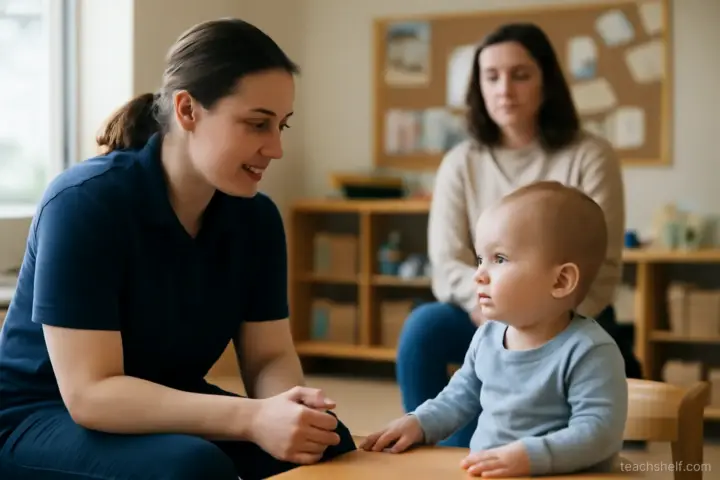
Conversations about a child's difficulties go badly for structural reasons far more often than because anyone involved is unreasonable.
The parent hears criticism of their child. The teacher feels defensive about their judgement. Neither leaves with a plan. A few habits change this reliably.
Before the conversation
- Be clear what you want to achieve. Information? Agreement on a plan? A decision? Write it in one sentence.
- Gather specifics. Dates, observations, examples — not impressions.
- Separate observation from interpretation. Saying he left the group four times this morning is an observation. Saying he is not interested is an interpretation, and it is where most conflicts start.
- Choose the setting. Never at pickup time in front of other parents.
- Allow enough time — a rushed difficult conversation is worse than a delayed one.
- Check what you already know about the family's situation.
Opening
- Say what the conversation is about in the first thirty seconds. Parents fill uncertainty with the worst possibility.
- Start with something genuine and positive — not as a technique, but because a child is never only their difficulty.
- State that you are on the same side. Say it explicitly; it is not obvious to a worried parent.
- Avoid opening with a judgement about the child's character.
The core habit: ask before you conclude
This is the single highest-value change:
- Describe what you have observed, then ask what they see at home.
- Ask whether anything has changed in the family's circumstances — a new baby, a move, a separation, an illness, a change in sleep.
- Listen fully before responding. Parents very often know the cause.
- Take notes and say you are doing so.
Many conversations that look like they will be about a behaviour problem turn out to be about something at home — and asking is the only way to find out.
Agreeing next steps
- Make the plan concrete — who does what, at home and at school.
- Keep it small. One or two changes are more likely to happen than five.
- Set a review date before the conversation ends. This turns a complaint into a process.
- Send a short written summary afterwards — what was discussed, what was agreed, when you will speak again. This prevents most later disagreements about what was said.
When a parent is angry
- Let them finish without interrupting. Most anger reduces once someone feels heard.
- Acknowledge the feeling without necessarily agreeing with the claim.
- Stay factual and calm — matching their tone escalates every time.
- If you were wrong, say so plainly. This ends far more conflicts than defending a mistake.
- If it becomes abusive, end the meeting politely and offer to continue another time, ideally with a colleague present.
- Write down what happened the same day, while it is accurate.
When you have to raise a concern
- Raise it early — parents are far angrier about being told late than about being told.
- Be specific and avoid labels.
- Say what you have already tried.
- Ask for their view before proposing anything.
- Know the boundary of your role. You can describe what you observe; you cannot diagnose. If a referral or specialist assessment may be needed, explain the process and who makes that decision — do not present a conclusion.
Serious concerns
🔴 If a conversation raises a concern about a child's safety or wellbeing at home, that is not a parent conversation to resolve on your own. Follow your setting's safeguarding procedure, inform the designated person immediately, and record what you observed in factual terms. Do not delay to gather more certainty.
Building trust before you need it
The best predictor of how a difficult conversation goes is what happened in the easy ones.
- Share positives regularly, not only problems — otherwise your name on the screen becomes a signal of bad news.
- Be reachable and reliable about response times.
- Be consistent — parents talk to each other, and inconsistency is noticed.
- Explain your reasoning when you make decisions, rather than only the decision.
One thing worth remembering
A parent hearing about their child's difficulty is not evaluating your professional judgement. They are worried.
Almost every technique in this article is a way of saying the same thing: make it clear you are working on the child's behalf, and then show them how.
Frequently asked questions
What is the most important preparation step?
Separating observation from interpretation. Describing what you saw is very different from stating what it means — and interpretations are where most conflicts start.
How should a difficult conversation open?
State what it is about within the first thirty seconds, because parents fill uncertainty with the worst possibility — and say explicitly that you are on the same side.
What is the single most useful habit?
Describe what you observed, then ask what they see at home and whether anything has changed. Parents very often know the cause.
How do you handle an angry parent?
Let them finish without interrupting, acknowledge the feeling, stay factual, and admit it plainly if you were wrong. If it becomes abusive, end the meeting politely and continue later with a colleague present.
What if a concern is about the child's safety at home?
That is not a conversation to resolve on your own — follow your setting's safeguarding procedure, inform the designated person immediately, and record what you observed factually.